Showing posts with label journalism. Show all posts

Confessions of a Goal Digger

Monday, December 7, 2015


I am a dreamer, a dreamer with goals galore. You can call me a “goal digger” if you’d like. I even have the T-shirt. My writing, blogging, and business goals are usually the last things I’m thinking about before I fall asleep at night and typically the first things on my mind in the morning. I’m constantly brainstorming ideas for blog posts, articles, and personal essays. I’m constantly pondering ways I can grow See Jane Write, my membership organization, and consulting service for women writers and bloggers. It’s probably not inaccurate to say that I am obsessed with my work. Is this healthy? Is this normal? I’m not sure that I care if it is or not.
Because of my goal-digging ways I spend the month of December ready to pop. I’m bursting with excitement for the New Year. And yes, I am one of those people who loves New Year’s Eve. In fact, I’d be fine with fast forwarding through the stressful and obscenely expensive holiday of Christmas and skipping right to Dec. 31.
Yes, I am one of those people who create a long list of goals and resolutions for the New Year and, yes, I believe in magic. I believe that the act of hanging a new calendar on my wall will give me all I need to keep these resolutions of mine and to bring my dreams to fruition. I know it’s silly, but I am unfazed. However, a highly successful blogger that I truly admire recently reminded me and her other fans that when you have big dreams you must respect the process. Don’t stay constantly fixed on your destination, she said. You must learn to enjoy the journey.
I especially need this reminder in December; otherwise I’ll spend the entire month counting down to midnight of January 1. But how do we goal diggers do this? How do we set our aspirations for the next year and look forward to 2016 yet still enjoy the final days of 2015?...
Read this entire article at B-Metro.com

How To Write Good Restaurant Reviews

Thursday, August 7, 2014


Image by David Schiersner via Flickr/Creative Commons

It's a good thing I've been exercising every day for the past seven months.

Birmingham Restaurant Week is coming up August 15-24 and I've been asked by the event organizers to visit and write about some of the participating restaurants. This is great news for my taste buds, but not-so-good news for my waistline. But I suppose I will have to make this sacrifice for my blog, right?


Birmingham Restaurant Week is a ten-day event that features some of Birmingham's best locally-owned and operated restaurants, offering prix fixe menus and drink specials. Last night the Birmingham Art Museum played host to the Birmingham Restaurant Week Preview Party. I had a fabulous night with friends at this sold out event sampling dishes from The J. Clyde, Silvertron Cafe, Maki Fresh, Rusty's Bar-B-Q, Dixie Fish Co., Davenport's Pizza, Oscar's at the Museum, and other participating restaurants.

We're smiling because we'd just had the bread pudding from Silvertron Cafe. 


Birmingham Restaurant Week is a great chance to try new restaurants or visit old favorites and blog about your experiences. But when you're penning your posts you want to have something more interesting and insightful to say than, "This dish was yummy!"

So I turned to food writer Jason Horn for help. Horn is a senior editor at Liquor.com and is the co-founder of FoodBlogSouth, the food blogging conference held annually in Birmingham. He's also worked for CHOW.com, Cottage Living, Cooking Light, and VisitSouth.com, and his food writing has appeared in B-Metro, Birmingham magazine, and on MagicCityPost.com.

Jason Horn

If you're planning to write about a restaurant, what should you order when you visit? 

"In order to a review a restaurant well you have to try a lot of different things," Horn says. "When The New York Times reviews a restaurant the reviewer goes 2, 3, or 4 times with other people so they get to try pretty much the whole menu."

If you’re trying to review a place based on one visit, Horn suggests that you at least bring a date and try anything your date orders.

If the restaurant is famous for one dish, order that dish, but also try other things on the menu. 

"If it’s famous for one dish there’s going to be a lot of coverage out there about that one dish and you want to do something that will be different," Horn says. 

Ordering the special of the day can be hit or miss, but if the special is a new dish that may be added to the menu later, you should definitely try that, Horn recommends. 

All in all, just order as you would normally,  but bring along a friend who doesn't mind sharing so you can try his or her food, too.


Mark your calendars! Birmingham Restaurant Week 2014 is Aug. 15-24. 


What kinds of questions should a writer ask her waiter or waitress? 

It depends on the restaurant, Horn says. For example, don't expect your server at a casual neighborhood grill to recommend a good wine, but feel free to ask about his or her favorite dish. 

Horn says it's best to be as specific as possible when asking questions of the staff. So instead of asking "What's good?" give your server an idea of what you're in the mood for. If you're torn between two dishes, ask which one he or she likes better. Instead of asking what wine goes well with your dish say something more detailed like, "I'd like a red and something in this price range and I don't like Cabernet," Horn suggests. 

"How well informed the servers are can be the line between a good and a great restaurant," Horn says. "If the chef is doing wonderful things but the servers don’t know anything about them or don’t have an opinion or can’t help you pick the right dish, that’s a big problem."


Can you give some tips on how to effectively describe the taste of food? 

If a dish has an unexpected flavor combination, talk about that and if it works or not, Horn says. "Compare it to other things if it’s similar to something you’ve had before but some important aspect has changed."

For example, let's say you're writing about a cocktail and the restaurant offers a Manhantan but the bartender uses gin. You can talk about that difference and if it worked for you or not. 

"Or if you have a burger -- what about that burger is different and is that good or bad?" Horn says. "It’s all about being specific. Talk about aspects of the dish that you liked or didn’t like. Talk about combinations of things that worked or didn’t work. You can even say I wish there was more whatever in this. Or I wish this was sweeter or I wish this was less sweet."


When reviewing a restaurant, comment on the layout, setup and atmosphere, in addition to discussing the food.
Image by Edinburgh Blog via Flickr/Creative Commons


When writing a restaurant review what else should a writer comment on in addition to the food?

"Service is always important and that should be an aspect of the review," Horn says. Notice how the staff deals with rude people. If someone is a jerk and the staff handles that person exceptionally well, "that's definitely worth mentioning," Horn says. 

Horn admits, though, that for him the food is still most important. "For me good food can redeem bad service, but good service can't redeem bad food." 

Pay attention to the set up, layout and atmosphere. "Does what the restaurant sell itself as match up with the restaurant that you get?" Horn says. "A lot of restaurants are pretty loud. If you’re in a barbecue joint and it’s loud and raucous, that’s fine. It’s supposed to be that way. If you go to an expensive date spot and it’s like that, that’s not.  If you go into what’s supposed to be a romantic restaurant and you can’t hear your date that’s a problem."

Writing about a restaurant for your blog is quite different than writing for a major publication. On a blog you can talk more about your personal tastes. So if you hate green beans and a dish has green beans it's OK to have a little fun and talk about that a bit. 

But be sure to take your personal tastes into consideration when assessing the food. "If there is something you didn't like step back and consider if there was a flaw in the dish or if it was your personal taste," Horn says. 

But also just have fun. 

"What it comes down to it it’s all about whether it appeals to you or not.  There’s no universal thing that’s delicious to everybody. If there was there would only be one restaurant and it would only serve that dish."

For more information on Birmingham Restaurant Week 2014 visit BhamRestaurantWeek.com

How I Learned to Stop Worrying and Love My Name

Tuesday, December 31, 2013


Today I launched a portfolio website to showcase my writing and public speaking and I decided to simply call this website Javacia.com. Most people would argue that I should have called it JavaciaHarrisBowser.com, since that is my byline. But I chose to go with Javacia.com as a tribute to my first name.

My first name is the only one I can rely on. Little known fact: my name has been legally changed four times even though I’ve only been married once.  Let me explain. When I was born I was named Javacia Nicole Price. Then my folks got hitched and I became Javacia Nicole Harris. But my mom lost the paper work so when I got my license I was Javacia Nicole Price again and remained that way for a year until my mom got the necessary documents to have my name changed AGAIN. Then I got married and changed my name to Javacia Nicole Bowser. Then I decided I missed my maiden name and changed my name to Javacia Harris Bowser. It's a miracle I even know my name.

Despite its dependability, I haven’t always liked my first name. As a girl, while my friends were thinking of names for their future kids, I would sit in my room jotting down ideas for the pseudonym I would use when I became a published author. For years I hated my name. I was disrespectful of my name, calling it “ghetto.” When people had trouble pronouncing my name I apologized as if I and the syllables it took to address me had somehow offended them. When they looked at me as if I were a green girl from Mars and said, "Well, that's different," I felt ashamed. And when they turned to me with a furrowed brow and asked "Do you have a nickname?" I just laughed and said, "You can call me J." 

Then I became a journalist. And I fell in love with my byline. I became a journalist and that “ghetto” name Javacia was on the pages of The Seattle Times, The Chicago Sun, USA Today, and national magazines.

I’ve been told that having a name like Javacia is a liability because as soon as you see my name you know I’m black long before ever you see me. I’ve been told that having a name like mine could make jobs hard to come by, that I’d be passed over by certain employers. For years I considered going by my middle name Nicole. But then I thought to myself, “Do I really want to work for someone who would discriminate against me because of my name or race?”

Don't get me wrong. I'm in no way judging people of color who do alter their names for the sake of acceptance or a job. People do what they have to do. 

And I decided that what I had to do was learn to stop worrying and love my name. 

That same line of thinking also helped me decide to describe myself, on my new professional website, as a writer, speaker, and feminist. Yes, I used the f-word. Doing so made sense even though I recognize it was a risky move. I don’t want to do any writing or public speaking for someone who is anti-feminist. And feminism is not only a part of my work, it’s a huge part of who I am. 

My name is Javacia and I am a feminist. Can you handle that?


The Journalista Project

Tuesday, November 26, 2013

image via

I have been posting a lot lately about wanting to start a feminist blog. But what I haven't mentioned is that I also have about a dozen other ideas for new websites. (Obviously, I can't pursue them all. I can barely find time to shower as is. But the ideas linger, nonetheless.)

One idea I got a few months ago was to start a blog (or to revamp this one) to focus solely on my efforts to be a journalist on my own terms. I haven't worked as a full-time journalist since 2009, but reporting is still in my bones. I still freelance often and I still see story ideas all around me all the time. And even though I call blogging the love of my writing life, I am still a journalist. When I attended Blogalicious in October I felt most confident not when I was talking about my blog but when I was interviewing people, when I was reporting. It felt so natural.

But I don't want to be a staff writer for a newspaper or magazine. I do, however, want to make a difference with my words and I want to be a role model for other female journalists, especially after watching a TED Talk by reporter Megan Kamerick on how women are underrepresented in the news media and how this results in incomplete stories.

It seems no matter what I do it all comes back to women and writing. It all comes back to inspiring women to share their stories and finding the courage to share my own.


Support Public Radio

Thursday, October 10, 2013


This year, I was also tapped to blog on race and diversity issues for wbhm.org and I've been writing on topics such as Black History Month, feminism, interracial marriage, and GirlTrek

And this summer WBHM was a sponsor for the See Jane Write Magazine launch party. 


My local NPR station has certainly been good to me and now it's time I return the favor. 

The WBHM Fall 2013 Membership Campaign is going on now through Oct. 19 and on Tuesday, Oct. 15 I will be on air between 4 and 6 p.m. to help raise financial support for the station. 

Donations of any amount are much appreciated and you can opt to give a one-time gift or monthly contributions. If you give $90 or more you'll receive a pint glass featuring original artwork by  Véronique Vanblaere of Naked Art Gallery! 


I'd love if some of my friends and followers would call 800-444-9246 or visit wbhm.org while I'm on the air to make a donation. Or if you'd like to pledge your support in advance, please visit my personal pledge page: 


Be sure to tune in on Tuesday, Oct. 15. 


Build Your Tribe (and Your Resume) With Twitter

Thursday, October 25, 2012

Twitter escultura de arena
Photo by Rosaura Ochoa
Image via Flickr/Creative Commons

Believe it or not, there are still people who don't understand the purpose of social media. Some people still think social networking sites are just a high-tech form of teenage gossip and a colossal waste of time. These people couldn't be more wrong.

For writers, social media could be the key to landing your next freelance gig. For example, the editor for one of the websites I write for found me through LinkedIn. And last year I had the opportunity to write a few articles for my one of my favorite online magazines because of Twitter. I began following one of the site's editors on Twitter and whenever she would post articles and encouraging words that really resonated with me I would let her know by replying to her tweets and she graciously responded. Then one day I decided to ask her, through Twitter, about writing for her publication. She sent me her email address (which I'd tried finding in the past to no avail) and I sent her a few story pitches. A week later my byline was on the site. 

But this is just the tip of the iceberg. Through Twitter you can not only find writing gigs, but also other writing gals! I have met so many ambitious, creative, and forward-thinking women writers in Birmingham thanks to social media. I was inspired to write this post because of a coffee date I had last week with a new friend who goes by the Twitter handle @see_clair_write. 

We met a few weeks ago at a panel discussion on the future of journalism, but we truly have Twitter to thank for our connection. This event was thrown by people who actually do understand social media, and the organizers encouraged attendees to tweet questions and comments during the talk. Those tweets were projected onto a screen at the front of the room and used to help guide the conversation. Not only did @see_clair_write catch my eye because of her awesome Twitter handle, but I was intrigued by and agreed with her insightful tweets. So I retweeted a few of her posts. Then I saw she retweeted a few of mine. 

When the panel discussion ended I leapt from my chair on a mission: I had to find this @see_clair_write. Evidently, she had the same idea and we walked straight to each other. (This is why you need a photo on your Twitter account, people. If you still have that stupid egg as your avatar please fix that right now. Go on. I'll wait...)

Clair and I exchanged information and last week sat in Urban Standard coffee house for hours talking about writing and so much more. 

This is surely the beginning of a beautiful friendship and we owe it all to you Twitter! 


Crossposted at See Jane Write


Love Letter to Journalism

Friday, October 5, 2012

Lost love letters
Image via Flickr/Creative Commons


Dear Journalism,

Some people threw you a party last night, but I doubt you had much fun. 

The event, organized by Birmingham's NPR station 90.3 WBHM, was called Issues & Ales: The Future of Journalism in North Central Alabama

So many people in the room kept lamenting about how the Internet is changing you and changing you for the worse. I can appreciate their position. The Birmingham News, the city's paper of record, is, as of this week, no longer a daily paper. While it produces and posts online content every day, it now only publishes a print product three times a week. 

One person in the room even suggested that you change your name. He said that you aren't about keeping a "journal" so why do we call you "journalism."

But Andre Natta, editor of community news website The Terminal and one of the special guest speakers at this shindig, stepped in and said, "The journal we are keeping is the journal of the communities that we serve."

And I believe this journal isn't any less important just because it's moving in a more digital-focused direction. 

Journalism, I still believe you can save the world. 


WBHM General Manager Scott Hanley (far left) with the panelists.
From left: Vickii Howell, Andre Natta, Kyle Whitmire, and Bob Sims. 

Another attendee questioned whether or not you will still be able to preserve our history, as you once did, in your new form. 

Vickii Howell, another special guest and editor of BirminghamView.com suggested that because of the Internet that recorded history can be even richer. The Internet democratizes information so that we can now see history through multiple lenses, she said.  

I must admit there were moments when everyone in the room disappeared and I began to think about us, about our rocky relationship. 

I'm not even sure how you feel about me these days. You're probably mad at me. You probably feel like you've become my #2, that I'm a part-time lover, that I treat you like the "side chick" as the kids say. 

It's true. In July 2009 I left you to become a full-time educator. 

But I missed you like crazy. So I started freelancing for every newspaper, magazine and website that I could write for because I needed you.  

I know this isn't how we imagined our life together would be when I was 15 and dreaming of starting a magazine. But I hope you'll stick with me, nonetheless. 

And I hope the people of Birmingham, and every city, will stick with you. 

Someone in the crowd wanted to know how the local paper will be able to retain high quality content amid all the changes. Bob Sims, content director for AL.com, an online hub for news from around Alabama and another panelist at this event, said he was confident that the passion of the people who work for the news organization would ensure this.

“People work in journalism because they have a passion for good storytelling,” he said.

Good storytelling – that’s what you are, journalism, and that’s why I yearn to be called one of your own. I miss being called a journalist.

These stories may be told in different ways nowadays, but that doesn’t change who you are. You are still the field I fell in love with so many years ago.

And so I write -- even if it means juggling three regular freelance gigs with a full-time teaching job and, getting an average of 5 hours of sleep a night. No matter what, I will write. 


Kyle Whitmire (far right)

Kyle Whitmire, another guest speaker and local politics and news reporter for The Birmingham News, shared that he was in high school when he decided he wanted to be “a newspaper man.” While he still obviously cherishes the newspaper, he is not naïve about the realities of the industry. Yet, he’s optimistic still.

“I may not end my career as a newspaper man,” he said, “but I hope I will end my career as a journalist.” 

What I'm trying to say, journalism, is I hope we can be together forever.

Writeously yours,
j.


Monday Motivation: How to Keep Your Dreams Alive

Monday, September 10, 2012

Glass
Image via Flickr/Creative Commons


When I was 15 years old I declared, "When I grow up I'm going to start my own magazine." And for the next few years I would talk to anyone who'd listen about my magazine dreams and even carried around a red binder with plans for my future publication.

Then came adulthood and the decline of journalism and my dreams started to seem more and more impossible. Eventually, I decided it would be best to just abandon this goal.

But no matter how hard I tried to let go of this dream, it refused to let go of me. So today I am declaring that:
God willing, I will one day start my own magazine.

After deciding to make this declaration once again I started thinking about how we all can keep our dreams alive and here's what I've come up with:

Remember to let your dreams evolve. As a teen when I imagined myself as a magazine editor/publisher I imagined myself producing a print publication in chic office in New York. But things change. I changed. Today my dream looks a lot different. My publication will most likely be online and the office I now daydream about is a cozy one in the Innovation Depot here in Birmingham.  But still the dream lives on.

Remember to choose your friends wisely. I have a few close girlfriends that I've been chatting with recently about renewing my commitment to my dream and they have been so encouraging. They've been getting me fired up about going after my goals. If you have friends that are notoriously negative, keep your dreams to yourself (until you find some new friends).

Remember it's not all about you. A woman I know once said that it's important for her to pursue her passions not just for her own sake but for her daughter's as well. It's important for her child to see her be brave enough to go after her goals. Though I'm not a mother I completely understand what she means. Because I don't have kids I'm able to devote a lot of my time to empowering other women -- which is what I think is my life's purpose. So I'm not striving to achieve my dreams simply for my own sake, but to show other women out there that they can do the same.

What dream are you fighting to keep alive?

Celebrating Julia Bluhm and Finding Hope in New Media

Monday, July 9, 2012

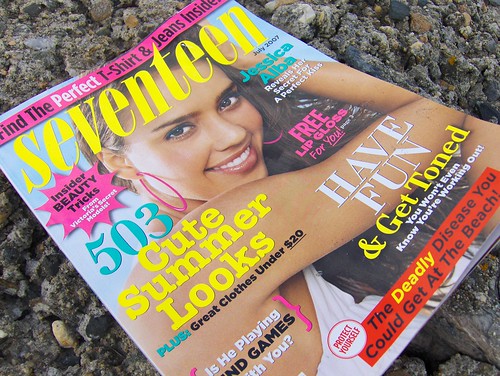
Seventeen
Photo Credit: Joe Shlabotnik (Flickr/Creative Commons)


Eighth-grader Julia Bluhm made history and headlines last week when her petition and protests led to Seventeen magazine pledging to not ever alter the face and body shapes of young women featured in its editorial pages. 

After hearing too many girls in her ballet class complain about their weight, Bluhm launched a petition on Change.org in April calling for the magazine to print one unaltered photo spread each month. Later she held a demonstration at the corporate offices of Hearst, the company that owns Seventeen. The petition garnered over 84,000 signatures. 

Last week the New York Times reported that. Ann Shoket, the magazine’s editor in chief, wrote in the editor’s letter in the August issue that the magazine had drafted a "Body Peace Treaty," promising not to change girls' body or face shapes (something Shoket insists the magazine has never done, anyway) and to include only images of real girls and healthy models. This is no doubt a response to Bluhm's campaign. 

As a feminist, this story makes me rejoice with the hope that perhaps we will see more and more magazines  start to feature realistic images and celebrate all types of beauty. As a writer, I can't help but think about the fact that Bluhm's crusade would not have been a success without new media. 
Not only did the Internet allow Bluhm to collect more than 80,000 signatures, but the Web also offers plenty of competition for magazines like Seventeen, as Melissa Harris-Perry pointed out on her show Saturday. With a host of blogs and online publications out there offering girls the tailored beauty, fitness, and fashion advice they could once only find in Seventeen, even this iconic magazine knows that despite its status readers are precious and their complaints need to be taken seriously. 
Many writers are afraid of what new media means for our future. Does it mean the death of newspapers, magazines and print books? I don't know. I hope not, but it could. But that doesn't mean our voices will be silenced. Julia Bluhm's story shows us that new media is a great opportunity for all of us -- whether we're activists or artists -- to make our voices heard like never before. 


Maybe you're a rebel with a cause who starts a petition like Bluhm did, or writer who publishes an e-book that inspires legions of people, or a blogger who creates an online publication that's an alternative to the magazines out there that don't seem to tell the stories of your community. 


I live in a city where many of the local newspaper reporters were recently laid off. And the newspaper at which I worked before I moved here no longer exists. So, I have good reasons to have a woeful attitude about new media, but stories like Julia Bluhm's reminds me I have a good reason to have a hopeful attitude instead. 

In Memory of Mando Montano and His Love for Journalism

Tuesday, July 3, 2012

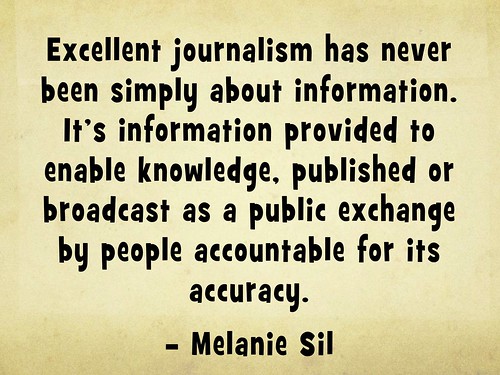
journalism’s public service functions: accountability, timeliness and accessibility @ Melanie Sil @melaniesill #openjournalism
Photo Credit: Ron Mader via Flickr/Creative Commons

Yesterday morning when I logged onto my favorite social networking sites I was immediately faced with the sad news of the death of Armando Montano, a 22-year-old Associated Press intern. Montano, who was working this summer as a news intern for the AP bureau in Mexico City, Mexico, was found dead early Saturday. 


Montano’s body was found in the elevator shaft of an apartment building near where he was living. The circumstances of his death are being investigated by Mexican authorities.


Even though I didn't know Montano, news of his death hit me hard and not just because he was so young. In the summer of 2003, I too was an AP intern. Montano and I were also both part of the Chips Quinn Scholars program, which offers journalism students of color hands-on training in journalism and mentoring by caring news veterans.


In a Nov. 2007 column for the Denver Post, Montano, who was a Colorado Springs, Colorado resident, wrote about his desire to become a journalist despite the fact that most people would consider journalism a dying field. He wrote: 

Journalism is changing, newspaper circulation is falling, and people are even turning away from broadcast news. So why do I want to be a journalist in this day and age?
For the thrill of getting a hot story. So I can inform the public about wrongdoing. So I can be part of a system that represents and protects democracy.
Just because journalism is changing doesn't mean that we have to discard its best principles. From where I stand — a high school teenager looking for my life's direction — those principles are easy to find.

Chuck Dean, senior political reporter for The Birmingham News, shared his reflections on Montano's words yesterday on Twitter and said that though he's been a reporter for a generation he's "never read better words about why good reporters do what they do or better advice as our craft changes." I couldn't agree more. 

Regardless of your profession, there is a valuable lesson to be learned here from someone who was only beginning to live his life. No matter how circumstances shift and the landscape around you changes, hold on to principles. Ask yourself why you pursued this profession, this passion, in the first place and figure out a way to carry out that purpose no matter what. 

Thank you, Mando, for your wise words. 


See Jane Freelance

Wednesday, May 16, 2012

Last night my organization See Jane Write Birmingham hosted its third educational event, Freelancing 101. This panel discussion featured writers and editors of top local publications and drew about 50 attendees. Complete with free refreshments and time to network with other local writers, it was a great way to spend a Tuesday night. (But I might be a bit biased.)

Here is a taste of the writing wisdom the panelists shared with us.

Carla Jean Whitley is managing editor of Birmingham Magazine and she loves coffee. I mean, she really loves coffee, and that’s actually good news for you. One of the pearls of wisdom Carla Jean shared at Tuesday’s panel discussion is the value of building relationships with editors, and you can start simply by inviting them out for coffee. Over a cup of jo you can pick their brains about their publications and their freelancing needs.

This is not to take the place of doing your homework, first. Before attempting to freelance for a publication it’s important that you be familiar it. “Read more than one issue,” Carla Jean suggests. All panelists agreed that you must get to know a publication’s style and have a sense of its audience to successfully pitch story ideas.

And speaking of story ideas, Carla Jean says that one of the best ways to come up with stories to pitch is to simply follow your curiosity. “If you’re interested someone else may be too,” she said. “Keep your eyes open.”

Glenny Brock is editor-in-chief of Weld, a newsweekly that she and three partners founded last year. Even though Glenny couldn’t “give a hoot about hunting and fishing," some of the best writing advice she ever received was from a man who specialized in this very topic. (Fun fact: Glenny’s first freelance piece was published in a magazine called Varmint Masters.) From this writer/editor, Glenny learned how important it is for a writer to see stories everywhere. “He never did an interview for just one story,” she said. Glenny believes that by asking the right questions, a good reporter can retrieve information and details for five stories in one interview. “Use every part of the animal,” she said, no pun intended. So if you’re doing a profile on a fisherman also find out some of his favorite fishing spots, the best places to buy fishing gear, etc. These can be the starts of more stories.

As for pitching your ideas Glenny said it’s important to be as specific as possible. So don’t email her saying you want to write a story about running. Instead consider pitching a story about a running group or new marathon in town. Your pitch will also be more appealing, she said, if you already have a few sources in mind for the story.  

When Chianti Cleggett talks about writing her face lights up and she sounds as joyful as a girl with a new crush. But this isn’t puppy love. Chianti has had a long-time love affair with the written word.  Chianti has been featured in various publications including The Birmingham Times, Birmingham Magazine, and Essence.com. Many of her writing opportunities have come from others being award of her love of writing. All her friends and family know it’s her passion so they’re constantly sending her leads.

Panelist Kate Agliata said Tuesday night that, “Good writers are constantly reading,” and Chianti is a prime example of that. You’ll often find her in a book store delving into magazines. This is a great way to generate story ideas. Chianit and Glenny recommend looking for ways to localize national stories or taking a local story and finding a national angle.

Afraid of pitching to national publications? Don’t be. Chianti says it never hurts to just go for it. “Take a stab in the dark,” she said. “What do you have to lose?”

One of the best pieces of advice Kate Agliata ever received was: “Write what you know.” Kate has been doing just that working as a writer and editor for MyGreenBirmingham.com, Birmingham’s online green living resource. Her work has also been published by several nationally recognized websites including HGTVPro, HGTVRemodels, and Got2begreen, one of Time magazine’s 2009 best rated websites.

If you’re thinking, “Well, I don’t feel like a know much,” you need to change that ASAP, sister. Kate recommends really focusing on a few of your interests and developing an expertise in those areas. That doesn’t mean you know everything. In fact, you need to stay thirsty for more knowledge. If you read something and you have questions, seek out the answers, Kate said. Chances are you’ll stumble upon a story idea in the process.

All of this may be a lot to take in, but if you remember nothing else, take this to heart: keep writing. All four panelists agreed that the best way to see your byline in your favorite publications and the only way to realize that dream of being a successful full-time freelancer (successful meaning you can pay your bills without eating Ramen noodles for dinner every night) is to write as much as you can. Get your name out there even if it means writing for a tiny community paper or even a newsletter for a local organization. And, yes, even if it means occasionally writing for free.

But in the midst of the hustle don’t lose your love for language. Chianti, for example, sets aside time once a week to simply write for pleasure.

And Kate’s advice is this: “Write every day, even if only for 5 minutes.”