Showing posts with label media. Show all posts

How WBHM Saved My Relationship with Radio

Tuesday, February 5, 2013

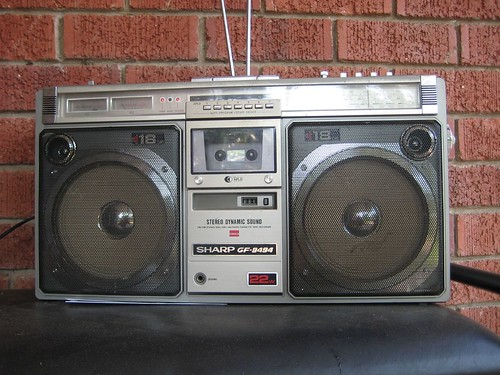
Ghetto Blaster
Image by Stephen Barnett via Flickr/Creative Commons

"I think I'm in love with my radio
Cause it never lets me down
And I fall in love with my stereo
Whenever I hear that sound"
- "Radio" by Beyonce


When I was a teenager I believed no one could love me like my radio.

It was always there for me. I listened to the radio while getting ready for and riding to school each morning. My radio made evening homework sessions go by faster and every night my radio sang me to sleep.

I still have fond memories of calling my favorite DJ to request my favorite song and then waiting by the radio with a blank cassette in the tape deck so I could record the highly anticipated track.

R&B ballads by the likes of Mariah Carey gave me fuel for all the sad, angst-filled love poems I wrote  back then. And the anthems sang by girl groups like TLC stirred within me a sense of self-pride that would eventually blossom into my feminism.

Then one day everything changed. Radio and I grew apart.

I could try to blame it all on mainstream music.  I could say rap music became too sexist and senseless and that pop and R&B became too trite. But, truthfully, I'm the one who changed. My favorite artists became folks like Ani DiFranco, musicians who don't get mainstream radio airplay.  And club bangers started to give me a headache.

So I turned off my radio.

Enter WBHM, Birmingham's NPR station.

I admit that in the past I was never a huge NPR fan because I felt the radio was supposed to be a source of escape and entertainment. As I grew older I started tuning in to NPR for updates on major news events, but was still far from a loyal listener.

But when I moved back to my hometown of Birmingham I decided to give WBHM a chance. I quickly got hooked on station's programming and was impressed by events like Issues & Ales.

Radio and I began to rekindle the flame.

I am a fan of good music for the same reason that I am a writer -- I love stories. And WBHM is always telling me an intriguing tale whether it's about life for children in Palestine or the story of a gay man being reunited with his siblings after being cast out the family by his ultra conservative father. Just yesterday I learned about the evolution of hand dryers and last week I began my day listening to an inspiring interview with Sonia Sotomayor.

I've become one of those people who are almost late for work because they're sitting in the parking lot in their cars enraptured by an NPR feature report. Every weekend I look forward to listening to the word game Says You.

But what about music? Well, if it weren't for WBHM I would have never learned about the artist Kendra Morris, whose album Banshee was one of my favorite releases of 2012.

Now WBHM and I are taking our relationship to a new level. We're really making things official. I've signed on to be a Race & Diversity blogger for the station's website. You can check out my debut post here.

And I leave you with this...

This Is What a Ladyblog Looks Like

Friday, February 1, 2013

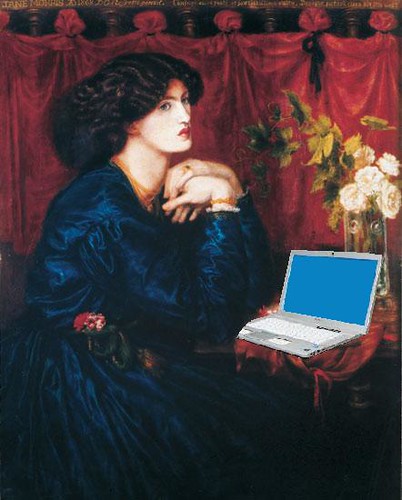
Jane Morris Blogging, after Dante Gabriel Rossetti
Image by Mike Licht via Flickr/Creative Commons

Exactly a year ago today Salon published an article by Autumn Whitefield-Madrano that made me want to leap from the sofa and start clapping. The article is titled "In Defense of Ladyblogs" and is in response to a piece by Molly Fischer that was quite critical of such sites.

A ladyblog is a website that is, obviously, written for women, by women. These sites not only discuss traditional women's issues but give them signature treatment . They're often considered an alternative to (and sometimes even a watchdog of) women's glossy publications as they tackle serious and controversial topics that many mainstream magazines tend to avoid and cover these topics with a distinct voice.

Fischer, in her article, argues that as these ladyblogs become more popular they also become more trite as they make room for too much fluff and lose the focus on the serious content found in other alternative women's media, such as explicitly feminist spaces. She believes many of these sites have gone sort or even absurd over time. Fischer says that essentially ladyblogs have become an adult online slumber party. “The Internet, it turned out, was a place to make people like you: the world’s biggest slumber party, and the best place to trade tokens of slumber party intimacy—makeup tips, girl crushes, endless inside jokes,” Fischer writes. 

But Whitefield-Madrano argues that these virtual sleepovers are a good thing and I completely agree.

Whitefield-Madrano believes that ladyblogs can and often do foster sisterhood and reminds us that oftentimes friendships are forged in the fluff.

Think about your best friend. Sure, you've cried together while talking about your dysfunctional family, your failed relationships, and your broken dreams. Perhaps you've even gone through a serious health crisis together. But you've also shared clothes and makeup tips, confessed crushes to each other, and sat side-by-side while watching ridiculous movies.

Furthermore, some of the explicitly feminist blogs, even those that I love, can feel alienating. As a feminist who is also a woman of faith, I sometimes wonder if my religious beliefs would be ridiculed.  Also, as Whitefield-Madrano says, "if explicitly feminist blogs are the only acceptable online outlet for feminists to inhabit, we’d get exhausted mighty quickly." 

This is partly why I've struggled with the idea of really working to establish myself as a feminist blogger in the first place. The idea of constantly writing about gender equality made feel like I needed a nap. 

I'm not implying that ladyblogs are perfect or above reproach. I've read plenty of articles on the ladyblogs mentioned in Fischer's piece that have caused me to strain my eye-rolling muscles. And in a follow-up piece Fischer brings up a great point about the notion of sisterhood stating that "second-wave sisterhood was always suspect, especially to the many women it ignored: women who weren't white, women who weren't straight, women who weren't comfortably bourgeois."

But this is exactly why I believe (and have even been told by my feminist friends) that I need to continue work on my blog. My goal is to create a blog that is feminist and fun, insightful and inclusive.

So today, on the anniversary of the publication of Whitefield-Madrano's piece, I am here to declare that The Writeous Babe Project is a ladyblog.

This means you can expect plenty of discussions about feminism and gender equality issues. You can also expect posts about writing, not only because I'm a writer, but because I see writing as a feminist act. But sometimes I may also post a picture of what I wore to a party, my workout regimen for the week, or my latest girl crush. And I want you to share the same in the comments, on my Facebook page, and with me via Twitter.

I'm throwing an online slumber party here and you are all invited.

Why I Love Being a Woman

Monday, November 19, 2012


Last week Glamour magazine hosted its annual Women of the Year Awards. Honorees for 2012 include the likes of actress Selena Gomez, photographer Annie Leibovitz, Girls creator Lena Dunham and USA gold medal Olympians. (Click here for a complete list.)

As Evette Dionne mentioned on her blog, The Huffington Post's women's website, Huff Post Women, captured the spirit of the evening at a reception dinner, asking several honorees and attendees this question: "What do you appreciate most about being a woman?"

This got me thinking: What do I love most about being a woman? It didn't take long for me to reach an answer.

The thing I appreciate most about being a woman is sisterhood.

I believe in the power of sisterhood.

Most women understand that when we band together we are an unstoppable force.

In my nearly 32 years on this earth in this female body I have learned that your good girlfriends make accomplishing goals more manageable and a lot more fun -- whether you're working toward artistic or professional aspirations or a goal to get in shape.

This #bloglikecrazy challenge is a perfect example.

I've now blogged for 19 days straight even though I've been juggling my full-time teaching job, freelance writing assignments, and church and family obligations. I've also had to make time to develop writing prompts to send to other bloggers participating in the challenge. One of the primary reasons I've been able to do this is because of ladies of See Jane Write and other female bloggers across the country who've been blogging like crazy with me. Their posts keep me inspired; their energy keeps me motivated.

And what I've seen happen this month on the See Jane Write Facebook group page has been fascinating.
I've mentioned before that the women of See Jane Write have been sharing their blog posts with the group and have been forming incredible connections, even with women they've never met IRL, as they discover things they have in common. But what I've also seen is women who were intimidated by blogging or had left their blogs sit dormant for months getting in on the action too. They've started or relaunched blogs because they saw we were having so much fun.

All this has inspired me to strive to take See Jane Write to even higher heights and I know I can do it because my sisters will be there to help me along the way.

Crossposted at the See Jane Write blog

An Open Letter to Taylor Swift

Thursday, November 15, 2012

Taylor Swift by David Shankbone 2010 NYC
Image by David Shankbone via Flickr/Creative Commons


Dear Taylor,

I wasn't going to write about this. By now it's old news that last month when interviewed by The Daily Beast you said you're not a feminist Actually, when asked if you considered yourself a feminist your exact words were: 
I don’t really think about things as guys versus girls. I never have. I was raised by parents who brought me up to think if you work as hard as guys, you can go far in life.
Taylor, I understand where you're coming from. When I was your age I wouldn't call myself a feminist either. I would say things like, "I'll start calling myself a feminist when feminists stop bashing men."

Little did I know feminism isn't about bashing men. It's not about "guys versus girls" as you said. Feminism is the belief in the social, political, and economic equality of the sexes. Period. Sure, there may be some misguided women who disparage men in the name of feminism, but that is not the true spirit of the movement. 

In fact, feminism is helpful for men as well, because they too are harmed by sexism. Gender stereotypes tell men they can't show emotion, that they're only worth as much as their last paycheck, and that their physical strength is more important than their intellect.

My goal here isn't to convince you to identify as a feminist, but I want you to know that feminism is about creating a world where women can "work as hard as guys" and actually "go far in life." Perhaps you think a women's movement is no longer necessary since women can't legally be held back from pursuing any career to which they aspire. But we can't deny that women still aren't paid as much as their male counterparts. Women in leadership positions who are no-nonsense and assertive are often called a "bitch" while women who are nurturing to their employees are viewed as weak. And female politicians are frequently asked more about their wardrobes and families than their policies. I could go on and on, but my point is there is still work to be done. 


Sincerely,
Javacia  


Another Reason to Love Sonia Sotomayor and Sesame Street

Wednesday, November 14, 2012


On a recent episode of Sesame Street, Supreme Court Justice Sonia Sotomayor let Abby Cadabby and girls everywhere know that while pretending to be a princess is fun, it is not a career. Instead they can and should aspire to be a teacher, lawyer, doctor, engineer, or even a scientist. “A career," Sotomayor says, "is something that you train for and prepare for and plan on doing for a long time.”

And donning her judicial robe, Sotomayor's presence and wise words lets girls know they can pursue any career they want, even a career as a judge. 


Thank you, Sotomayor, and thanks Sesame Street! 


h/t Feministing

Celebrating Julia Bluhm and Finding Hope in New Media

Monday, July 9, 2012

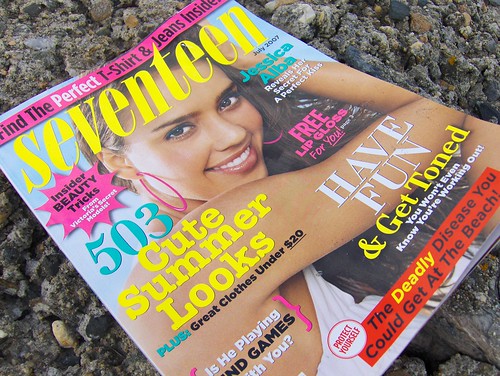
Seventeen
Photo Credit: Joe Shlabotnik (Flickr/Creative Commons)


Eighth-grader Julia Bluhm made history and headlines last week when her petition and protests led to Seventeen magazine pledging to not ever alter the face and body shapes of young women featured in its editorial pages. 

After hearing too many girls in her ballet class complain about their weight, Bluhm launched a petition on Change.org in April calling for the magazine to print one unaltered photo spread each month. Later she held a demonstration at the corporate offices of Hearst, the company that owns Seventeen. The petition garnered over 84,000 signatures. 

Last week the New York Times reported that. Ann Shoket, the magazine’s editor in chief, wrote in the editor’s letter in the August issue that the magazine had drafted a "Body Peace Treaty," promising not to change girls' body or face shapes (something Shoket insists the magazine has never done, anyway) and to include only images of real girls and healthy models. This is no doubt a response to Bluhm's campaign. 

As a feminist, this story makes me rejoice with the hope that perhaps we will see more and more magazines  start to feature realistic images and celebrate all types of beauty. As a writer, I can't help but think about the fact that Bluhm's crusade would not have been a success without new media. 
Not only did the Internet allow Bluhm to collect more than 80,000 signatures, but the Web also offers plenty of competition for magazines like Seventeen, as Melissa Harris-Perry pointed out on her show Saturday. With a host of blogs and online publications out there offering girls the tailored beauty, fitness, and fashion advice they could once only find in Seventeen, even this iconic magazine knows that despite its status readers are precious and their complaints need to be taken seriously. 
Many writers are afraid of what new media means for our future. Does it mean the death of newspapers, magazines and print books? I don't know. I hope not, but it could. But that doesn't mean our voices will be silenced. Julia Bluhm's story shows us that new media is a great opportunity for all of us -- whether we're activists or artists -- to make our voices heard like never before. 


Maybe you're a rebel with a cause who starts a petition like Bluhm did, or writer who publishes an e-book that inspires legions of people, or a blogger who creates an online publication that's an alternative to the magazines out there that don't seem to tell the stories of your community. 


I live in a city where many of the local newspaper reporters were recently laid off. And the newspaper at which I worked before I moved here no longer exists. So, I have good reasons to have a woeful attitude about new media, but stories like Julia Bluhm's reminds me I have a good reason to have a hopeful attitude instead. 

3 Lessons We Can Learn from Chris Routly

Tuesday, March 13, 2012


You've seen it before: commercials for things like diapers and detergent that not only suggest that women are the sole caregivers in a family, but also imply that when dads are in charge we're in for trouble. For example, Kimberly Clark's HUGGIES has a new campaign promoting its diapers and wipes trumpeting "Dad" as "The Ultimate Test" for their products. 

In one commercial, for example, the voiceover says: “To prove Huggies diapers and wipes can handle anything, we put them to the toughest test imaginable: dads, alone with their babies, in one house, for five days, while we gave moms some well deserved time off. How did Huggies products hold up to daddyhood?"
Some of the promotional materials even implied that dads would neglect changing a soiled diaper to finish watching the game. 

After reading something like this on a feminist blog you may think "How sexist?" but when watching the commercial at home you probably didn't give it a second thought because ads like these are all too common. 

But one man did notice, and he decided to do something about it. 

Fed up, illustrator and blogger Chris Routly, who is a a stay-at-home dad, decided to speak out and started a petition calling for an end to "Ultimate Test: Dad" element of the company's advertising. And it worked. 

After getting media attention and collecting over 1,000 signatures, Routly announced Friday on his blog, The Daddy Doctrine, that Huggies/Kimberly Clark reached out to him and outlined a list of changes the company plans to make to its campaign including airing a new TV spot featuring real dads out and about with their babies to test the diaper. 

Even though I'm not a parent, Routly's story really struck me because I believes it teaches us three valuable lessons:

1. Dads aren't dumb. And dads are caregivers too. In fact, as Routly mentions in his petition, even though full-time at-home dads are still statistically few in number, according to the 2010 U.S. Census, approximately one in three dads regularly acts as their child's primary caregiver, while their spouse works, in a two-parent household. 

2. Sexism hurts men too. So often when I have a conversation with someone about feminism I get questions like "Well, women have rights now. What's the point?" or "Isn't feminism unfair to men?" But gender stereotypes are alive and well and women aren't the only ones affected by them. When we say that caring for the home and for children is woman's work, we're not only implying that women who work outside the home are sub-par parents, but we're also suggesting that stay-at-home dads are somehow not real men. Or we make assumptions that men simply can't be good caregivers, period. That's not OK and these are exactly the kinds of  things feminism exists to challenge. 

3. You can make a difference. Chris Routly could have just sat home and complained about these commercials to his family and friends. But he did more. He wrote about it on his blog and filed a petition through Change.org. And his efforts paid off, showing we don't have to be politicians or policy makers to effect social change.