Feeling Like Fiona

Thursday, June 28, 2012

Nearly every poem I wrote in college was in someway inspired by singer/songwriter Fiona Apple. Many of these poems were bad, really bad, but for better or worse, Ms. Apple was my muse. 


When I heard about the deluxe edition of her new album The Idler Wheel Is Wiser Than the Driver of the Screw and Whipping Cords Will Serve You More Than Ropes Will Ever Do, more simply known as The Idler Wheel, I had to have it. Downloading some digital copy from iTunes just wouldn't do and here's why: instead of an ordinary jewel case, the deluxe version of the CD comes in a journal and with a DVD of Apple's performances at this year's SXSW festival, a poster, and two postcard-size prints. You had me at journal. 


The journal includes the lyrics to each track, handwritten by Fiona herself, some of her artwork, and even random studio production notes. I was eager to get my hands on this hoping it would give me some glimpse into the psyche of the mysterious Fiona Apple. She inspires me and I want to know what inspires her. 


As Fiona says in the refrain of the song "Every Single Night," I just want to feel everything. By delving into the pages of her journal while I listened to her music I was hoping I would somehow feel what she felt when she wrote those words. Silly, I know, but it was a fun experiment, nonetheless, as I lay in the middle of the floor (because I imagine this is what she does when she creates and because this is what I did in college) drinking in her lyrics. 


I must say I'm a bigger fan of her earlier releases, but The Idler Wheel, Apple's fourth studio album, is still a must-have for any Apple-head (yep, I just made that up) and both her voice and the music have a very raw feel to them that I love.


Fiona Apple inspires me because the music she creates is what I consider real art, not just entertainment. I've mentioned on this blog before that I believe true art inspires and transforms the people who encounter and understand it, even if only in a small way. Apple inspires me with her use of metaphor. Take, for example, this verse from "Werewolf": 
I could liken you to a werewolfThe way you left me for deadBut I admitI provided a full moonI could liken you to a sharkThe way you bit off my headBut then again, I was waving aroundA bleeding, open wound


Moreover, I believe that real art teaches us something about ourselves and Fiona Apple's music always does just that. Long ago, while listening to her lyrics, I discovered that I am not an easy woman to love. Fortunately, I've found friends and an amazing husband who are up to the challenge, but I am still keenly aware of this dark truth about myself. In "Left Alone" she writes: "How can I ask any one to love me/ when all I do is beg to be left alone."  Boy, can I relate to that. We writers can be weird that way. 


Fiona Apple was my poetic muse and later in college even inspired a number of my short stories. I hope that one day she'll influence a piece of creative nonfiction I write too. Well, actually, I guess she already has. 


What musicians inspire you? 
Why I Write

Wednesday, June 27, 2012

Kristen - hands
Photo by Angie Garrett via Flickr/Creative Commons


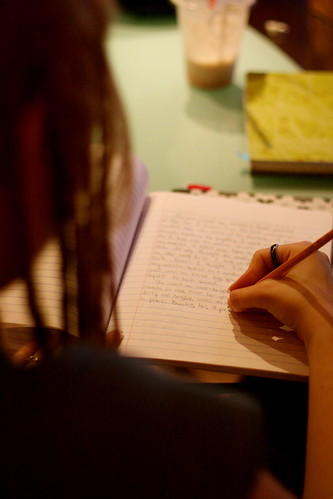
The temperature is quickly climbing to 100 degrees. I find refuge in a cool corner of a coffee shop and a mason jar of iced mango green tea.

I’m here on a mission to answer one simple, little question posed in a thick, heavy book that I’ve been toting around for a week. It’s a writing exercise composed of a one sentence prompt: Why do you write?

Open journal. Pick up pen. Ready. Set. Go.

I write for the sake of my heartbeat, to remind myself that I exist.
I write because I can’t help myself.
I write when my hand trembles in fear of the thoughts haunting my mind.
I write between lines for those cast aside to the margins.
I write to punish. I write to praise.
I write to hold tight to grudges. I write to forgive.
I write to feel sincere. I write to expose myself as a fraud.
I write to feel human. I write to feel divine.
I write as an act of prayer, each sentence a chant, a hymn, a meditation.
I write as an act of play, to feel free as a girl flying high in her favorite swing at the neighborhood park.
I write to find community. I write to escape to my own little world.
I write because I want you to love me.
I write to be immortal. I write when I feel ready to die.
I write because I believe that in the end stories are all we have.


Why do you write?

R.I.P. Nora Ephron

Tuesday, June 26, 2012

114468652AP013_TechCrunch_D
Photo by Joe Corrigan
Courtesy TechCrunch via Flikr/Creative Commons

“My mother wanted us to understand that the tragedies of your life one day have to potential to be the comic stories the next.”  -- Nora Ephron


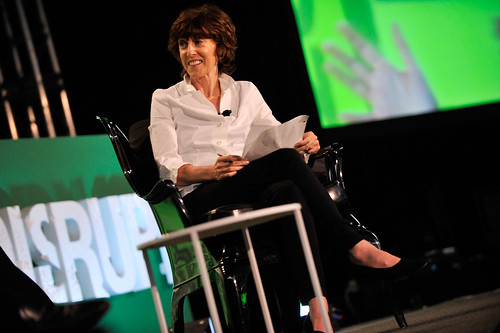
Author and screenwriter Nora Ephron died Tuesday at New York Presbyterian Hospital, where she was being treated for acute myeloid leukemia and pneumonia


While I am, of course, familiar with Ephron's movies such as Sleepless in Seattle, When Harry Met Sally and Julie & Julia, it wasn't until I started reading her obituaries that I realized how much more she had accomplished and the example she set for  women writers. 

As the Los Angeles Times notes, Ephron's "protagonists, who included the chef Julia Child and the whistle-blower Karen Silkwood, were often women and typically were just as capable — if not more so — than the men around them."

And as Mariam of Redbone Afropuff mentioned in a comment to a recent post on the blog, Ephron showed her that "yes, I can be a journalist, a novelist, a memoirist, and essayist, a screenwriter and a playwright all in one lifetime." 

Just to give a sampling of what she accomplished off screen, in the 1960s Ephron worked for the New York Post and then went on to write monthly columns in the 1970s for Esquire and New York magazines. Many of the pieces she wrote for these magazines were collected in three books of essays, Wallflower at the Orgy (1970), Crazy Salad: Some Things About Women (1975) and Scribble, Scribble: Notes on the Media (1979). 

Examples of more recent writings include her 2006 collection of essays, I Feel Bad About My Neck: And Other Reflections on Being a Woman and her 2010 collection of essays, I Remember Nothing, which takes a humorous look at the aging process and other topics.

Prolific is a word that just doesn't seem to fully describe her career, a career I'm sorry I didn't explore more when she was still with us. But her legacy remains to remind us to keep writing, writing, writing and to tell our stories no matter what. 

Let's Eat at AlaBlogMeet!


Alabama Bloggers


Birmingham resident Rachel Callahan had made connections with writers all over the world, thanks to her popular blog Grasping for Objectivity. But she knew very few bloggers in her hometown. She searched for a website that helped local bloggers connect, but with no luck. 


"So I decided to create one," Callahan says. 


Callahan launched Alabama Bloggers in May of 2009 and eventually took these online connections to real life with regular meetings now known as #AlaBlogMeet. The next meeting is at 11:30 a.m. Friday at The Silvertron Cafe, 3813 Clairmont Avenue in Birmingham. I'll be there and I hope those of you in town will join me. 


"When I started the site, I said that I would provide meet-ups, but I didn't really mean it," Callahan confesses. "I was scared to death to meet people in real life! But one of the original members called me on it and offered to host the first one. We had 19 people show up, and I enjoyed every minute of it."


Since then the group has had a meetup at least every other month. 


What can you expect if you're a first-timer? 


"Lots of laughter, banter, and some really good blogging advice mixed into the cracks," Callahan says. "You're sure to walk away with some new friends. And we always have at least one first-timer at every meetup, so don't be afraid!  You're always welcome."


Click here to RSVP if you plan to attend the Alabama Bloggers June #AlaBlogMeet. 


Crossposted at See Jane Write Birmingham

Monday Motivation: "You Are a Writer"

Monday, June 25, 2012


Book Review: You Are a Writer by Jeff Goins


“I am a writer.”

Each morning when I wake I whisper this sentence to myself. It’s become a mantra, a prayer. 

This new daily meditation of mine was inspired by Jeff Goins’ latest book You Are A Writer.

Goins is an accomplished writer, blogger, and speaker based in Nashville, Tennessee. He’s contributed to well-known sites like Copyblogger and Problogger and has a wildly popular blog of his own at GoinsWriter.com, which is all about writing and making a difference in the world with words.

The tagline of You Are A Writer is “So Start Acting Like One” and fortunately Goins gives his readers plenty of practical steps on how to do just that.

Sure, the book has plenty of encouraging words to help us on those days when we’re wondering if all the hard work is worth it. But Goins mostly gives us writers some tough love and reminds us it’s time to get to work. As a friend once told Goins years ago, exactly when he needed to hear it: “You are a writer. You just need to write.”

It’s time out for just thinking about writing and talking about writing, it’s time to get busy writing!

And stop writing only what you think people want to read, Goins says. Write for yourself. “Stop writing for accolades, and start writing for passion,” he advises, echoing the central message of his previous book The Writer’s Manifesto. Amazingly, what you will find, Goins says, is that “when you stop writing for readers’ affections, your work will affect more people.”

One of the points of this book that resonated with me most is the idea of choosing yourself. As writers we need to stop waiting to be picked and just pick ourselves. I sure needed to hear that. For years I’ve been waiting to be picked by my favorite magazines, newspapers, and websites and by the feminist in-crowd that I stalk follow through blogs and Twitter.

Goins says we must choose ourselves.

Goins’ book includes a very helpful and informative section on how to pitch to editors and publishers of magazines and websites, but he also gives us a formula for reaching a point in our careers where we can ditch the pitch, a point where the editors, the publishers, and the cool kids are coming to us.

To do this you’ll need three things, Goins says: a platform, a brand and channels of connection. 

Your platform is your stage, a place from which you communicate such as a blog, newspaper column, speaking career, YouTube channel, or Podcast. To build your platform you need to spend time getting good at your craft, show people you know what you’re doing, and generate buzz around your work.

Building a brand is about choosing a name (which can be as simple as the one given to you at birth or something quirky like Writeous Babe), an image (which can be a logo or just a nice headshot) and your voice (which is your writing style).

Channels of connection include email, Facebook, Twitter, conferences, meetups, etc.

None of this, however, will work without building authentic relationships. Even though Goins wants us to write for passion, not the praises of other people, this does not give us permission to be jerks. Throughout the book Goins stresses the importance of building the trust of our audience and importance of being generous. Be a resource to others, just as Jeff Goins has used his blog, his books, and his platform to be a resource to us.

GeorgiaMae.com: Natural Hair and the New Black Beauty Culture

Saturday, June 23, 2012

Happy Saturday, babes! I've decided to start posting some of my best content from my blog GeorgiaMae.com here at The Writeous Babe Project too. Check out this post on natural hair and black beauty culture. 


***


Is natural hair the end of black beauty culture? 


That's the question posed by Cassandra Jackson in a recent article she wrote for The Huffington Post. Jackson says that while she is glad to see an increasing number of black women choosing natural hair (as opposed to chemically straightened hair) she worries that the shift toward natural hair also means a shift away from the black beauty salon, which for decades has been the center of black beauty culture. 


She writes:


While many, including me, celebrate the natural hair movement's emphasis on self-discovery, I cannot help but wonder if something has also been lost with this cultural shift. For all the horrible things about hair straightening, the experiences associated with it have created a powerful thread that connects the vast majority of black women. Even if you have kinky hair now, you probably have memories of time spent with family and friends in kitchens getting your hair done by someone who loved you and who you trusted enough to wield a sizzling hot straightening comb next to your ear. You probably remember that first trip to the beauty shop where black women talked about grown folks' business, and nearly every sentence began with the endearment, "girl." It does not matter if your mother was a teacher or housekeeper, or if you were in New York or Alabama because these experiences crossed class and region. Hair straightening was a rite of passage, an entry into the world of black women.


Personally, I've never been a fan of salons. They stink, they're hot, and you're in there for what feels like half your life. So the fact that wearing my hair in its naturally curly state meant fewer trips to a beauty shop was just more reason for me to embrace my curls. But, ironically, now that I'm natural I feel more a part of black beauty culture than ever before. Black beauty culture has not died; it has simply evolved. 


One of the things I love most about being natural has very little to do with my actual hair. I love being natural because of the sense of community and camaraderie that comes with it. At least once a week I have a conversation with a complete stranger in a clothing store at a shopping mall or in the aisles of the supermarket or in an aerobics class at the gym, and those conversations are sparked because of my curls. Those conversations begin with questions like "How long have you been natural?" or "What products do you use on your hair?" 


Furthermore, some of my closest friends that I've made since I moved back to my hometown have been through local natural hair mixers organized by groups like Birmingham Natural Beauties. At these mixers conversations begin with questions like those I mentioned before, but soon the discussions move to other topics -- our careers, our hobbies, our husbands, our dreams. And soon a friendship is born. 


And thanks to natural blogs we naturalistas can forge bonds with women all across the country or even the world. Through online communities we share stories of our transition from relaxed hair, we rant about our search for a stylist who can cut curly hair, and we rave about products that keep our tresses soft. And soon even these conversations can drift to topics like exercise, as many women begin to workout more after going natural, or healthy eating, as many women begin to reconsider what they're putting in their bodies once they start to think about the products they're putting on their heads. 


So, no, many black women no longer congregate in black beauty salons as we once did, but black beauty culture is alive and well. We naturalistas may not see the black beauty shop as the safe and sacred space as our mothers did but as we gather at natural hair blogs, conferences, and meetups, we are encouraged and we are supported because we are always reminded that we are beautiful. 

Feminist Friday: Why You Need a Girl Crush

Friday, June 22, 2012

Free Two Happy Girls Holding Hands Walking to School at Sunrise Creative Commons
Photo by D. Sharon Pruitt of Pink Sherbet Photography
Image via Flickr/Creative Commons


Melissa Harris-Perry, Sloane Crosley, and Crystal Renn. A political talk TV show host, a humor writer, and a supermodel. It seems these three women have nothing in common, but they do. They are all atop my very long list of girl crushes.

I've written about some of my girl crushes before, confessing my love for the likes of First Lady Michelle Obama, pop icon Beyonce, actresses Zoe Saldana and Scarlet Johansson, and broadcast journalist Soledad O'Brien. And lately it seems the girl crush has become some sort of phenomenon, regularly popping up in the media.

In a recent article for W magazine, Thessaly la Force explored what all this girl crushing could mean. She writes:
The “girl crush” may sound ­silly, but sometimes it takes something ­unserious to get us talking about a serious subject: the ambitions of young creative women and the need for ­worthy role models. Among my own nominees for inaugural members of the Girl Crush Hall of Fame are Zadie Smith, with her daring, brilliance, and wild success; Joan ­Didion, with her cool, spare prose; Patti Smith, with her soul and wisdom; Sofia Coppola, with her chic grace and unmistakable taste; and Tina Fey, with her goofy smile and razor wit. Each of them has accomplished something the rest of us dream of doing. And because they’ve done it, we feel we can too.
She's right. We all need role models, not superheroes, but real people doing the very things we want to one day achieve. And girl crushes are exactly that. 

Harris-Perry, an educator, black feminist writer, and host of The Melissa Harris-Perry Show on MSNBC, encourages me to hold fast to my feminist beliefs, even if they're not always popular, and shows that I can and should find a way to make my voice heard.  Sloane Crosley, author of I Was Told There'd Be Cake and How Did You Get This Number, is the model I look to as I dream of publishing a collection of essays. And Crystal Renn, plus-size supermodel and author of the memoir Hungry, motivates me to learn to love my body and write about my journey to self-acceptance once I've actually achieved it. 

Furthermore, Harris-Perry and Renn both teach a lesson about the importance of platform. If you have something you believe in -- whether it's feminism, empowering racial minorities, or promoting healthy body image in women and realistic beauty standards in fashion -- build a platform and get your voice heard. And you will find there are plenty of  people out there who feel the same and were just waiting for someone to speak up. 

Girl crushes can cultivate our creativity as they push us to work toward our artistic goals. 

But, wait! There's more. 

Thessaly la Force also argues that the prevalence of girl crushes could indicate a slight narrowing of the gender gap:

I can’t help but believe our current generation’s embrace of girl crushing signifies something larger: evidence that a professional world once dominated by men has evened out—maybe not totally, but to a reassuring degree. When ­Didion first set out to become a writer, she copied the sentences of Ernest Hemingway; today, my friends and I copy hers.

Young women dreaming of  hosting their own political talk TV show no longer have to solely look to Larry King. They have women like Harris-Perry as role models too. And anyone who says women can't be funny has clearly never read one of Crosley's essays. 

Who are your girl crushes and how do they help your creativity?